Five Reasons AI-Written Content Isn’t Working for SEO
AI content tools have changed how businesses approach SEO. What once took days can now be done in minutes. Unsurprisingly, many companies rushed to adopt these tools to scale their content production.
More blogs, more social media content, more website content. AI made everything easy. Sadly, easy doesn’t always mean good, and businesses are now seeing the negative side of unrestrained AI use in content production. Despite publishing more than ever, rankings are flat or even declining. Traffic is not growing, and engagement is low.
VF Agency has helped some businesses adapt their approach to tackle this issue. However, we are seeing business owners double down and publish even more AI-generated content. These people think volume is the problem; they’re wrong. In this article, we discuss five key reasons why AI written content is not delivering SEO results, and what needs to change.
– Lack of Original Insight
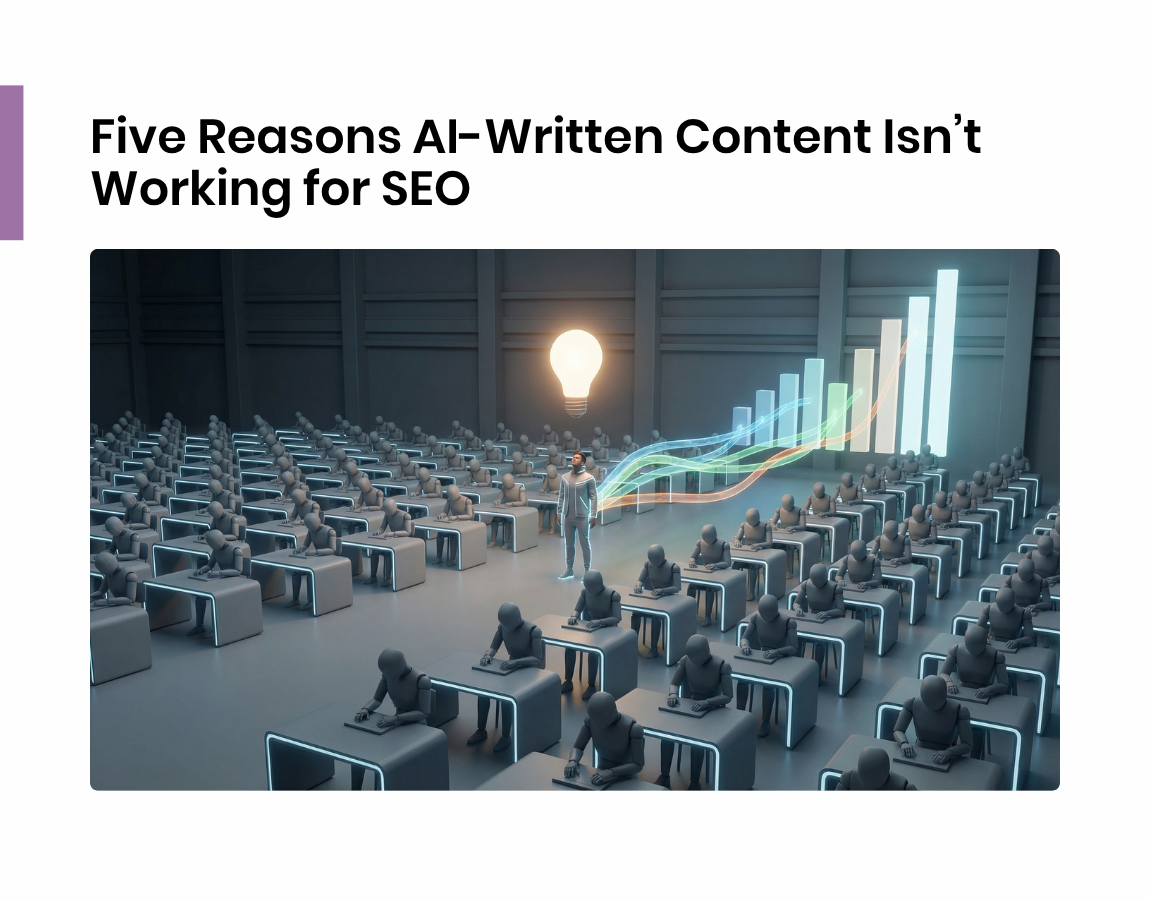
AI tools are trained on existing content. They do not have real-world experience, opinions, or insights. This means they often produce content that sounds correct but feels generic. In competitive search results, this is a major weakness. If your content says the same thing as every other page, there is no reason for search engines to rank it higher.
Read some of the articles you’ve been publishing. Do they add anything to the conversation? Are you providing any new insights? Strong SEO content needs a clear point of view. It should offer something new, whether that is expert knowledge, a unique angle, or real examples. Without that, content blends into the background.
– Weak Search Intent Alignment
One of the biggest challenges with AI-generated content is how it handles search intent. Yes, AI can generate readable text, but does it understand why a person is searching in the first place? Or is it guessing at their intent, generalising based on what other people are searching? AI isn’t human, which is why it produces broad answers that touch on a topic but do not fully solve the user’s problem. It has never used your product, or any other product for that matter.
This is why your content looks complete on the surface but lacks precision. Perhaps more dangerously, unless you prompt and fine-tune it extensively, AI does not work from real search data by default. Rather, it guesses at topics, structure, and priorities rather than building content around actual user demand. This often results in pages that miss the mark.
When people visit your website and the content there doesn’t match what they need, they won’t stay for long. That’s why your key engagement signals such as ‘time spent on page’ and ‘bounce rate’ are low, and this is limiting your ranking potential.
– Over-Optimisation and Keyword Stuffing
AI is often used with keywords as a starting point. But it struggles to understand how keyword coverage is actually built from real human search behaviour. Instead of mapping content to real queries, it tends to force keywords into the text. This creates repetitive phrasing and unnatural structure. The content may look optimised, but it does not read naturally.
More importantly, AI often fabricates relevance. It includes terms and phrases that are not grounded in real user search demand. This disconnect is something search engines can detect. As a result, the content can appear artificial. It feels like it was generated to rank, not written to help users. This also weakens trust and reduces performance.
– Lack of Authority and Depth
It’s been known for years that SEO has moved past standalone articles, and is now about building authority across a topic. AI struggles with this because it works one piece at a time. It is not natural for it to create content that is connected and builds depth or coverage. This is why many businesses today have isolated pages that do not support each other.
In competitive niches, this quickly becomes a problem. Search engines look for websites that demonstrate a strong understanding of a subject. This comes from consistent, in-depth content supported by internal linking and clear structure. Without this, even well-written pages can struggle to rank.
– Key Signals are Missing
Search engines place a strong focus on experience, expertise, authority, and trust. These signals help determine whether content is credible and reliable. AI-generated content lacks these qualities by default. It has no real experience, no author identity, and no brand perspective behind it.
This becomes even more important in industries where trust matters. Without clear signals of expertise, content can be seen as less reliable. To compete, content needs more than accuracy. It needs credibility. This is something AI alone cannot provide.
You Need a New Approach
AI has changed the way SEO works, and businesses and marketers need to adapt. The focus has shifted towards combining real search data with AI tools to produce better content at a faster pace. This means starting with actual user demand. Customer intent should always guide the structure, topics, and messaging of each piece. AI can be used to support production, but it should never replace strategy.
Another important shift is the rise of Answer Engine Optimisation. Content needs to be structured in a way that directly answers user questions or solves real-life problems, not just targets keywords. At VF Agency, this approach is already in practice. By combining search data, high intent customer queries, and AI-assisted workflows, we help our clients create content that is both scalable and effective. The result is stronger rankings, better engagement, and more meaningful traffic.
If your content is not delivering the results you expected, it may be time to rethink your approach. To speak with someone about adapting your SEO strategy to fit the demands of search engines in 2026, click here to schedule a one-on-one consultation.