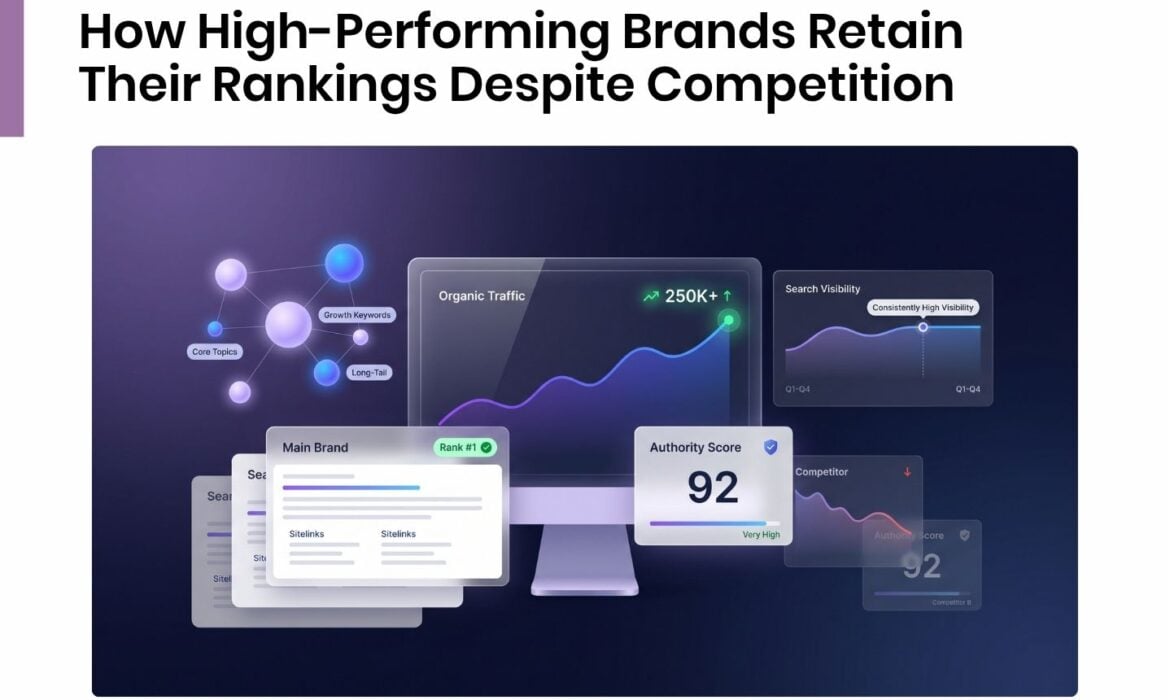
How High-Performing Brands Retain Their Rankings Despite Competition
In the past, you would need to visit several websites to learn, for example, which spa treatments work best for back pain. Because they know this, med spas can create blogs that answer your questions in the hope that you click on their web page. As you read the content in search of a solution, the business promotes its services and tries to persuade you to subscribe or make a purchase.
With the AI Overviews that are now prominent on search engines, this is no longer the case. If you search “best spa treatments for back pain”, an AI summary will answer your question without ever taking you away from the results page. As you can tell, this presents a big problem for sellers hoping that visitors click on their content and find out about their products. If people are getting direct answers and not clicking through multiple websites, how will they find businesses looking for customers?
This question has left many business owners unsure about where to focus. Should they optimize for AI visibility and leverage a fast-growing technology, or continue investing in traditional SEO and hope some visitors still click through? The answer is not one or the other. Google still dominates search, with nearly 14 billion searches per day. It remains the largest and most reliable source of organic traffic and revenue. At the same time, AI Overviews are becoming an important layer of visibility that can’t be ignored.
To succeed in this new landscape, you need a strategy that works across both. So below, we highlight three proven ways to rank on Google while increasing your chances of being featured in AI results.
Create Authoritative Content Driven by User Intent
Everything starts with understanding what your audience is actually looking for. User intent is the foundation of modern search. It goes beyond keywords and focuses on the reason behind a query. Many businesses still create content based on what they think people want. The result is often generic pages that don’t answer the questions posed by real people. This type of content will struggle to rank and rarely appears in AI summaries.
Authoritative content takes a different approach. It is built around real user needs. It answers specific questions, solves clear problems, and provides meaningful value. When your content aligns with user intent, it performs better across the board. Google rewards it because it provides real-life solutions. And AI systems favour it because it offers clear and useful suggestions that can be summarised and cited.
Structure Content for Both AI Systems and Search Engines
Even the best solutions can underperform if you don’t present them clearly. Structure plays a major role in how content is understood, ranked, and referenced. Search engines and AI systems process content differently, but they look for similar signals. They both favour clarity and relevance. They want content that’s well organized. Well-structured content makes it easier for Google to index and rank your page. It also makes it easier for AI systems to pull out key information and include it in summaries.
This means your content should follow a logical flow. Use clear headings to break down topics. Keep paragraphs focused and easy to read. Provide direct answers where possible, rather than burying them in long explanations. Also, AI systems often pull short, clear sections of a website’s content to generate answers. If your content is easy to scan and understand, it has a higher chance of being featured.
Leverage Strong E-E-A-T Signals
Search engines evaluate website content based on Experience, Expertise, Authority, and Trust (E-E-A-T). These signals help determine whether your content is credible and worth ranking. Here’s something interesting: Google has been using AI to do this, long before Claude or ChatGPT. So, it shouldn’t surprise you to learn that AI systems follow a similar logic. When generating answers, they are more likely to reference sources that appear reliable and authoritative.
Sadly, this is where many businesses fall short. Their content may be well-written, but it lacks depth, perspective, or credibility. Without strong E-E-A-T signals, it becomes harder to compete. Building these signals requires a clear strategy. Your content should reflect real knowledge and experience. It should show that you understand your industry and can provide valuable insights. Consistency also matters. Publishing high-quality content across related topics helps establish authority over time. When these elements come together, your content becomes more informative and search algorithms rate it as a trusted resource. This improves your chances of ranking on Google and being referenced in AI Overviews.
Final Note
The way people search may be changing, but the fundamentals of online promotion remain the same. Google continues to drive the majority of traffic, while AI platforms are shaping how information is delivered. Businesses that try to choose one over the other will struggle to get the best results. Your goal should be to combine both.
At VF Agency, we help businesses do exactly that. We use real search data, customer insights, and advanced automation tools to create and promote content that drives results. If you want to rank where it matters today while preparing for the future of search, now is the time to take a smarter approach. To learn how we can help your business grow, follow this link to view our services or schedule a one-on-one consultation with an expert.